
Today, operating an online store is similar to competing in a crowded marketplace where everyone is vying for customers’ attention at the same time. Because of this, companies that wish to increase online sales and cultivate enduring client relationships must comprehend E-commerce Marketing Tips. It is no longer sufficient to just launch a website. Consumers anticipate easy shopping, appealing product pages, prompt delivery, and interesting brand communications. In the cutthroat world of e-commerce, companies that disregard these standards frequently find it difficult to thrive.
The popularity of internet shopping has fundamentally altered how people purchase goods. These days, consumers can make decisions about what to buy in a matter of minutes by watching product videos, reading reviews, and comparing prices. This implies that in order for businesses to remain visible, they must have effective digital strategies. Effective e-commerce marketing strategies assist businesses in raising their search engine rankings, drawing in targeted traffic, and turning infrequent visitors into devoted clients. Every marketing initiative, from social media advertising to SEO optimization, supports the expansion of the company as a whole.
Trust is another crucial element in successful E-commerce Marketing Tips. Consumers purchase from companies they are familiar with and feel at ease with. Purchase decisions are significantly influenced by a well-designed website, active social media accounts, favorable reviews, and supportive customer service. E-commerce Marketing Tips can be compared to creating a link between your company and your target market. Customers will find it easier to interact with your goods and services if the bridge is stronger.r.
Understanding E-commerce Marketing
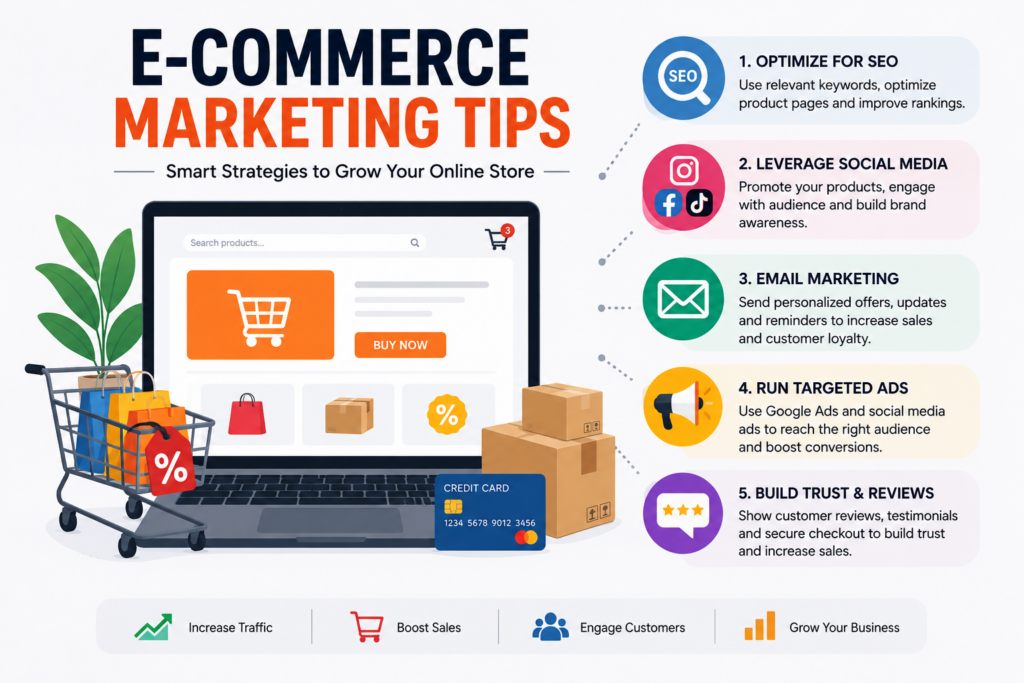
All promotional activities used to increase online store traffic and sales are referred to as e-commerce marketing. Search engine optimization, social media marketing, content marketing, email campaigns, influencer collaborations, and paid advertising are some of these tactics. Attracting potential customers and assisting them with the purchasing process are the primary goals. Effective e-commerce marketing strategies frequently result in increased customer engagement and improved brand visibility for businesses.
One of the main benefits of E-commerce Marketing Tips is the ability to target particular audiences effectively. Conventional advertising techniques frequently reach large audiences, many of whom might not be interested in the product. Businesses can target consumers using digital marketing tools according to their age, interests, location, online behavior, and shopping habits. Because users who are more likely to make purchases see advertisements, this increases conversion rates. These targeted E-commerce Marketing Tips help businesses reduce unnecessary advertising costs while improving overall sales performance.
Data tracking is another factor in the effectiveness of e-commerce marketing. Companies can keep an eye on sales trends, customer behavior, ad performance, and website traffic in real time. Marketers can use this data to make more informed decisions and continuously enhance their campaigns. Businesses can use analytics to understand consumer preferences and market trends rather than speculating about what customers want. A strong foundation for online success is created by combining effective data analysis with useful e-commerce marketing advice.
Developing a Powerful Brand Identity
One of the most important resources for any internet company is its brand identity. Consumers are more likely to remember brands with distinctive logos, uniform color schemes, polished packaging, and unambiguous messaging. Strong identities make companies stand out from rivals and foster strong emotional bonds with clients. Imagine walking into a mall where every store has the same appearance. It would be challenging to recall any particular brand. Online businesses are subject to the same rule.
Customers can quickly identify your company with a memorable logo and a unified visual style. Because they recognize the significance of first impressions, well-known e-commerce companies invest years in establishing trust through branding. Because branding has a direct impact on customer loyalty and purchase decisions, businesses that adhere to smart e-commerce marketing tips place a strong emphasis on it. Customer confidence can be greatly increased by a well-designed website with eye-catching graphics.
Brand voice is equally crucial in E-commerce Marketing Tips. Regardless of the tone you use—friendly, professional, or lighthearted—consistency is important in all forms of communication. Ads, product descriptions, email campaigns, and social media captions should all convey the same personality. Consumers value companies that communicate honestly and clearly. A strong brand identity eventually boosts customer retention and promotes repeat business, both of which are critical for long-term e-commerce growth, making it an essential part of effective E-commerce Marketing Tips.
SEO’s significance in e-commerce
An important factor in increasing organic traffic to online retailers is search engine optimization. Even the greatest products might go unnoticed by prospective buyers without SEO. Businesses that employ efficient e-commerce marketing strategies are aware that long-term traffic can be produced by ranking on search engines like Google without solely depending on sponsored advertisements. To increase a website’s visibility in search results, SEO entails optimizing its technical components, product descriptions, images, and content.
One of the first steps in SEO is conducting keyword research. Companies need to know what terms consumers use when looking for goods online. A consumer looking for the “best wireless headphones,” for instance, is probably prepared to buy. Search engines are better able to comprehend page content when titles, headings, and descriptions naturally contain pertinent keywords. Because it detracts from readability and rankings, keyword stuffing should always be avoided.
Product page optimization is just as crucial. User experience and SEO performance are enhanced by clear product titles, thorough descriptions, excellent photos, client testimonials, and quickly loading pages. Websites that offer useful information and easy navigation are rewarded by search engines. To remain competitive in search results, companies using effective e-commerce marketing strategies frequently update content, keep an eye on rankings, and enhance website performance.
Strategies for Social Media Marketing
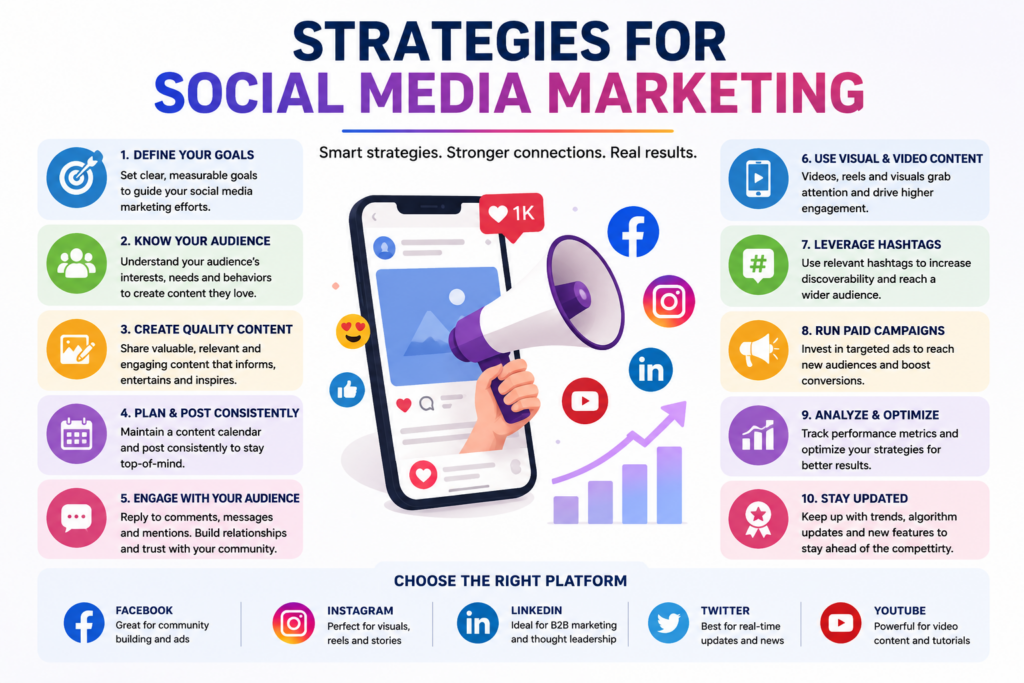
One of the most effective tools for e-commerce companies today is social media. Social media sites like Facebook, Instagram, TikTok, and Pinterest enable brands to interact with consumers directly and visually display their products. Companies that are adept at e-commerce marketing frequently use social media for relationship-building and storytelling in addition to promotion. Consumers like interacting with companies that regularly post interesting content.
Because images have a big impact on purchasing decisions, Instagram marketing is especially effective for fashion, beauty, food, and lifestyle brands. Brands can boost engagement by using user-generated content, short films, reels, and high-quality images. Additionally, social media enables companies to instantly communicate with clients via direct messages and comments. This exchange fosters loyalty and increases trust.
Due to its sophisticated targeting capabilities, Facebook advertising is still very successful for e-commerce. Companies can design campaigns that target lead generation, product sales, or website traffic. Because they remind consumers about products they have previously viewed, retargeting ads are particularly helpful. Astute companies constantly assess the effectiveness of their campaigns and modify their plans in response to the findings. Brand awareness and online sales can be greatly increased by combining regular social media activity with useful e-commerce marketing advice.
Strategies for Content Marketing
Businesses can naturally promote their products while educating, entertaining, and engaging audiences with the aid of content marketing. Businesses produce useful content that draws in potential customers rather than aggressively promoting sales. Blogging, making videos, product tutorials, buying guides, and social media storytelling are all examples of effective e-commerce marketing strategies. Over time, high-quality content builds customer relationships and increases trust.
Product descriptions are extremely important in e-commerce. Customers are rarely persuaded to purchase products by generic descriptions. In-depth and captivating product descriptions aid consumers in comprehending the features, advantages, and application of a product. Companies should concentrate on using their content to address consumer issues. For instance, brands can describe how a skincare product enhances skin texture and boosts confidence rather than just describing it.
Another great tactic for boosting website traffic is blogging. Relevant keyword-focused articles draw readers via search engines and offer chances for organic product promotion. Companies that consistently post educational content frequently appear higher in search results. Because search engines prefer websites with regularly updated content, consistency is essential. Long-term visibility and authority are produced by effective content marketing backed by tried-and-true e-commerce marketing strategies.
In conclusion
It takes more than just product sales to be successful in an online business. To draw clients, establish credibility, and promote recurring business, companies need clever tactics. In competitive markets, businesses can increase visibility, engagement, and conversions with the aid of effective e-commerce marketing tips. Every tactic, from social media marketing to SEO optimization, supports long-term expansion and financial success.
Businesses must keep up with shifting consumer expectations and trends as the digital marketplace continues to change quickly. Businesses that devote time to comprehending consumer behavior, enhancing user experience, and producing insightful content frequently outperform rivals. E-commerce marketing is a continuous process of learning, testing, and campaign optimization rather than a one-time endeavor.
Brands that prioritize customer satisfaction, authenticity, and consistency forge closer bonds with their target audiences. Using these e-commerce marketing strategies can help you build sustainable growth and boost online success, regardless of how big or small your online store is.
FAQs
1. What are the top e-commerce marketing pointers for novices?
To draw clients and raise brand awareness, novices should concentrate on SEO, social media marketing, content production, and email campaigns.
2. What makes SEO crucial for online retailers?
SEO raises organic traffic, boosts search engine rankings, and facilitates customers’ easy online product discovery.
3. How can social media benefit online companies?
Through visual content and advertisements, social media enables businesses to market products, interact with consumers, and raise brand awareness.
4. How does content marketing fit into e-commerce?
Customers are educated, trust is strengthened, website traffic is increased, and SEO tactics are supported by content marketing.
5. How can companies increase client retention?
Personalized emails, first-rate customer service, loyalty programs, and regular communication can all help businesses increase retention.