
What Is Marketing on Facebook?
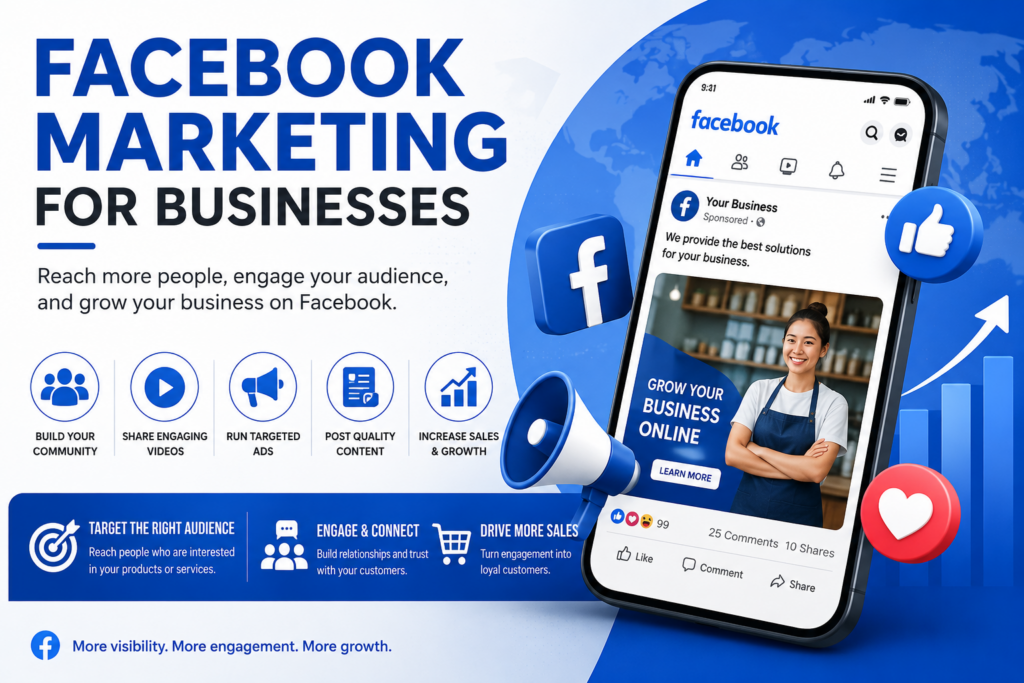
Facebook Marketing for Businesses is the process of using groups, videos, sponsored ads, organic posts, and audience engagement techniques to promote a company, product, or service on Facebook. Facebook continues to be one of the world’s most potent digital marketing platforms, despite the emergence of new social media apps. Facebook is one of the biggest online communities available to businesses today, with over 3 billion monthly active users worldwide, according to recent reports.
Facebook can be compared to a vast online marketplace. Imagine setting up a tiny store in the heart of the world’s busiest city, where millions of people pass by every day. Facebook provides businesses with just that. Facebook enables you to connect with customers who are already interested in your goods or services, regardless of whether you own a big corporation, a restaurant, a local clothes store, or an online coaching business.
Facebook Marketing for Businesses is used by companies for a number of purposes. While some concentrate on producing leads, boosting sales, or forging closer bonds with clients, others want more website traffic. Facebook allows brands to accomplish all of these tasks in one location. With Facebook Marketing for Businesses, you can post updates, reply to messages, make videos, run ads, and even create virtual communities through Facebook Groups.
Targeting is the main benefit. Conventional forms of advertising, such as television or newspapers, frequently display advertisements to everyone, even those who are not interested. Facebook marketing operates in a different way. Users can be targeted by businesses according to their age, interests, location, behavior, and purchasing patterns. This helps businesses reach the right audience at the right time and use their marketing budget more wisely.
Why Companies Will Continue to Use Facebook in 2026
A common question is whether Facebook Marketing for Businesses is still relevant today. The answer is yes, especially for businesses. Facebook continues to dominate local communities, audience targeting, and business marketing, even though younger audiences may spend more time on platforms like Instagram or TikTok. According to reports from 2026, more than 85% of social media users still maintain a Facebook account, making Facebook one of the most effective platforms for businesses to reach and engage their target audience.
Facebook’s varied audience is one of the reasons companies keep spending money on its marketing. Facebook draws users of all ages, in contrast to some platforms that primarily target younger users. Because of this, it is perfect for companies that cater to adults, families, professionals, and local communities. People between the ages of 30 and 55 make a lot of purchasing decisions, and they continue to be very active on Facebook.
Facebook’s sophisticated advertising system is another factor. Companies can design campaigns for particular objectives like online sales, lead generation, app downloads, or website visits. With AI-driven optimization tools that assist brands in automatically improving ad performance, Meta’s advertising technology has become more intelligent. Large marketing teams are no longer necessary for businesses to run successful campaigns. If they employ clever tactics and high-quality content, even small businesses can compete.
Another important component of Facebook Marketing for Businesses is community building. In 2026, Facebook Groups have become more significant as people seek deeper online connections. Instead of simply scrolling through random posts, users now join groups related to hobbies, local communities, fitness, education, and business interests. Brands that actively participate in these communities often build stronger trust, better engagement, and long-lasting customer relationships through effective Facebook Marketing for Businesses strategies.
Facebook’s ability to integrate paid advertising and organic marketing into a single ecosystem is another reason why businesses use it. A business can run highly targeted advertisements and publish free content every day. This equilibrium enables companies to increase brand recognition and lead generation without exclusively depending on sponsored advertising.
Facebook Marketing’s Advantages for Companies
Beyond just advertising, Facebook marketing has many other advantages for businesses. It supports long-term business growth, customer connections, and visibility creation for businesses. Brand awareness is one of the main benefits. Every day, millions of people browse Facebook, and regular posting keeps businesses visible to their audience.
People begin to recognize and trust a brand when they regularly see its content online. This is similar to seeing the same store during your daily commute to work. Over time, familiarity builds confidence and trust. In Facebook Marketing for Businesses, companies that consistently share valuable content, answer customer questions, and engage with followers often develop stronger customer relationships compared to brands that rarely interact online.
Another significant advantage is lead generation. Through lead forms, Messenger chats, or website visits, Facebook enables businesses to directly gather consumer data. Facebook enables you to actively reach potential customers rather than waiting for them to find your business organically. Lead generation advertisements are widely used by businesses to gather phone numbers, email addresses, or appointments.
Customer engagement is equally important in Facebook Marketing for Businesses. Traditional advertising methods are usually one-sided, where businesses talk and customers simply listen. Facebook completely changes this approach. Customers can comment on posts, send messages, leave reviews, and share their opinions instantly. This two-way communication helps businesses build stronger customer loyalty, improve trust, and create better relationships through effective Facebook Marketing for Businesses strategies.
Cost-effectiveness also makes Facebook marketing attractive. Small businesses with limited budgets can still reach thousands of people through targeted campaigns. According to industry reports, nearly 80% of small businesses use Facebook for marketing because it remains affordable compared to many traditional advertising channels.
Engaging customers is equally crucial. Conventional advertising techniques are typically biased. Customers listen when businesses speak. Facebook Marketing for Businesses totally alters that. Consumers can instantly share their thoughts, leave reviews, send messages, and comment on posts. This fosters two-way communication, which increases client trust and loyalty.
Facebook marketing is also appealing due to its affordability. Through targeted campaigns, small businesses with tight budgets can still reach thousands of people. Nearly 80% of small businesses use Facebook for marketing because it is still more affordable than many traditional advertising channels, according to industry reports.
Additionally, Facebook marketing yields quantifiable outcomes. Facebook Insights and Meta Ads Manager allow businesses to monitor impressions, clicks, engagement, leads, and conversions. This aids marketers in identifying what is effective and what requires development. Businesses can make data-driven decisions based on actual performance metrics rather than speculating.
Creating a Business Page on Facebook
A Facebook Business Page serves as a company’s online store. Facebook Pages require expert branding and unambiguous content, just as physical stores require eye-catching displays and well-organized layouts. Selecting the appropriate cover image, profile picture, and business name is the first step. Because it makes the brand instantly recognizable to customers, most businesses use their logo as the profile picture.
Because it explains to visitors what the company does, the “About” section is crucial. A common error made by companies is to leave this section unfinished. Clear service explanations, organic keyword usage, and contact details like phone numbers, email addresses, and website links should all be included in a compelling description.
When creating a brand identity, consistency is important. Companies should utilize consistent messaging, fonts, and colors throughout all of their marketing platforms. Customers may stop trusting you if your Facebook page appears antiquated while your website is up to date and professional. Professionalism and brand recognition are produced by a unified visual identity.
Since many consumers prefer messaging over phone calls, businesses should also activate Messenger as part of their Facebook Marketing for Businesses strategy. Rapid responses boost response rates and enhance customer satisfaction. Some companies even employ automated chatbots to provide prompt answers to frequently asked questions, ensuring that the brand remains accessible and helpful around the clock.
Another crucial step is to include call-to-action buttons. Businesses can add buttons like “Shop Now,” “Contact Us,” “Book Now,” and “Learn More” on Facebook. Instead of just browsing the page, these buttons encourage users to take immediate action.
Customer trust is also influenced by reviews and ratings. Positive reviews function similarly to online word-of-mouth advertising. Since social proof is a major factor in online purchasing decisions, Facebook Marketing for Businesses should focus on encouraging happy customers to leave reviews, as these testimonials directly impact the brand’s credibility and reach.
Facebook Content Techniques
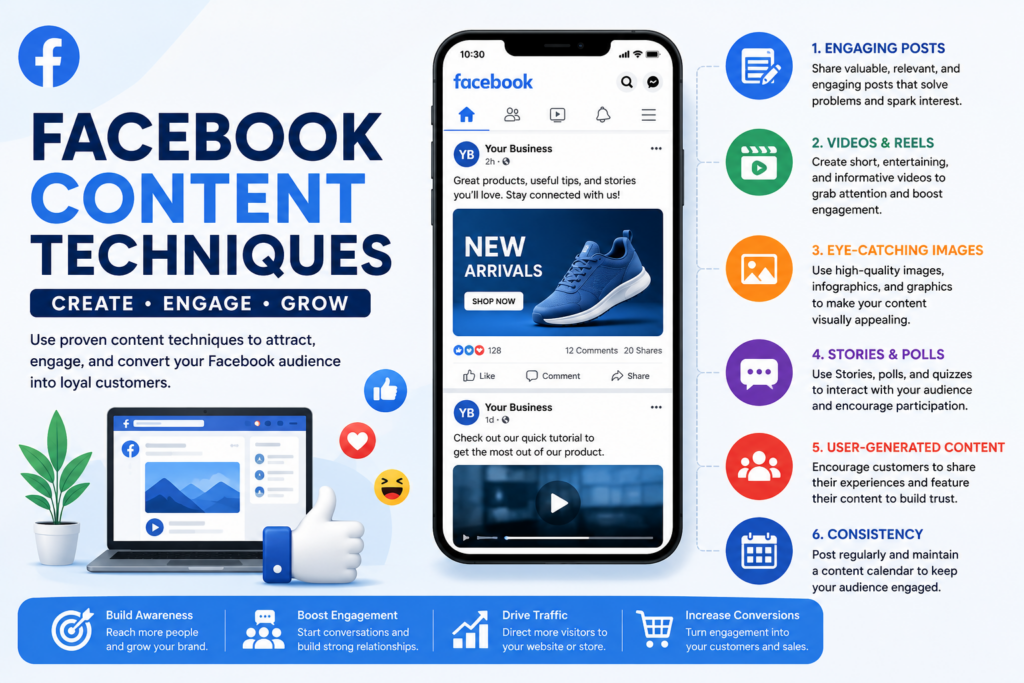
The core of Facebook marketing is content. Even the most effective advertising strategy will be ineffective without interesting content. Companies need to produce content that informs, amuses, motivates, or resolves issues. Selling goods continuously is not the only objective. No one likes to follow a page that is constantly advertising.
These days, videos do incredibly well on Facebook. According to reports, the reach of short-form video content, like Reels, is much higher than that of typical image posts. Videos quickly capture viewers’ attention and entice them to interact with content for longer. Videos can be used by businesses for product demonstrations, customer testimonials, tutorials, and behind-the-scenes footage.
Because people process visuals more quickly than text, images and infographics are also very effective components of Facebook Marketing for Businesses. Posts with excellent graphics are more likely to be shared and boost engagement. Simple visuals typically perform better, so businesses should steer clear of blurry images and excessively complex designs to maintain a professional and impactful presence.
One of the most successful Facebook marketing techniques nowadays is storytelling. Businesses should tell stories about customer experiences, company journeys, or real-life transformations rather than just saying, “Buy our product.” Emotional marketing frequently increases engagement, and stories foster emotional connections.
Equally crucial is consistency. Posting at random once every few weeks typically yields mediocre results. Companies should maintain consistent activity and adhere to a content calendar. This increases visibility in Facebook’s algorithm and keeps followers interested.
Engagement is also increased by interactive content such as question posts, live videos, polls, and quizzes. Because Facebook wants its users to stay active for longer, its algorithm favors content that promotes conversations.
Facebook Advertising for Companies
One of the most effective marketing tools on the platform is Facebook Ads. Advertising is more successful than many conventional marketing strategies because it allows businesses to target particular audiences with extreme precision. Businesses can show ads to users who are more likely to become customers rather than to strangers.
Facebook provides a variety of advertisements, such as retargeting campaigns, lead generation ads, carousel ads, image ads, and video ads. Every format has a distinct purpose. While retargeting advertisements are effective for regaining lost customers, video advertisements are great for raising awareness.
One of Facebook’s best features is audience targeting. Companies can target individuals according to their job titles, interests, online activity, demographics, and even past website visits. This degree of targeting aids companies in cutting back on unnecessary advertising expenditures.
Facebook Ads are also appealing due to their budget flexibility. Small companies can begin with a modest daily budget and progressively expand their campaigns. Facebook enables companies to test campaigns without taking significant financial risks, in contrast to traditional TV or newspaper advertising.
Campaigns for retargeting are particularly effective. Imagine going to an online store and then walking out without buying anything. The identical item later shows up in your Facebook feed. Retargeting is what that is. Within the scope of Facebook Marketing for Businesses, this tactic frequently greatly increases conversion rates by reminding prospective buyers about products they have previously viewed.
Ad performance should be routinely analyzed by businesses to enhance outcomes. Marketers can better understand the effectiveness of their campaigns by using metrics like click-through rate, engagement rate, cost per lead, and return on ad spend.
Assessing Facebook Marketing Performance
Monitoring outcomes is crucial for sustained success. Businesses cannot determine whether their marketing initiatives are effective without data. To track performance, Facebook offers analytics tools like Facebook Insights and Meta Business Suite.
Reach, impressions, engagement, website clicks, conversions, and follower growth are important metrics. While engagement demonstrates how users engaged with content through likes, comments, and shares, reach quantifies the number of people who saw a post.
Following ad clicks, businesses should monitor consumer behavior. If visitors do not become customers, high traffic is meaningless. By incorporating conversion tracking into their Facebook Marketing for Businesses, companies can learn which campaigns produce actual sales or leads, allowing them to optimize their budget and maximize results.
Another crucial tactic is A/B testing. To find the best-performing campaigns, businesses can test various headlines, images, videos, or audiences. Over time, even minor changes can significantly enhance advertising outcomes.
In conclusion
In 2026, Facebook marketing remains one of the most effective business tools. Facebook continues to offer unparalleled audience reach, sophisticated advertising choices, and robust community-building opportunities despite increasing competition from more recent social media platforms. Companies can achieve remarkable outcomes by combining strategic advertising, high-quality content, and regular engagement.
Posting sporadic updates is no longer the only activity on the platform. These days, creativity, storytelling, data analysis, and customer interaction are all necessary for successful Facebook marketing. Companies that solely concentrate on selling frequently face difficulties, whereas brands that foster trust and provide value typically expand more quickly.
Facebook marketing provides opportunities to engage with customers in meaningful ways, regardless of the size of your business. You can make Facebook a dependable growth engine for your company by knowing your audience, producing interesting content, and employing astute advertising techniques.
FAQ
1. Can small businesses still benefit from Facebook marketing?
Yes, Facebook marketing is still very successful for small businesses because it provides strong audience engagement opportunities, local targeting, and inexpensive advertising.
2. What kind of content works best on Facebook?
Facebook is typically the best place for videos, reels, narrative posts, infographics, and interactive content like polls.
3. How much should companies spend on Facebook advertisements?
Budgets differ based on industry and goals. A lot of small businesses begin with modest daily budgets and grow according to their performance.
4. What makes Facebook groups crucial for companies?
Through insightful conversations, Facebook groups assist companies in developing communities, boosting engagement, and forging closer bonds with their clientele.
5. How can companies increase Facebook interaction?
By posting frequently, utilizing videos, posing queries, answering comments, and sharing insightful content, businesses can increase engagement.