
Social Media Marketing: What Is It?
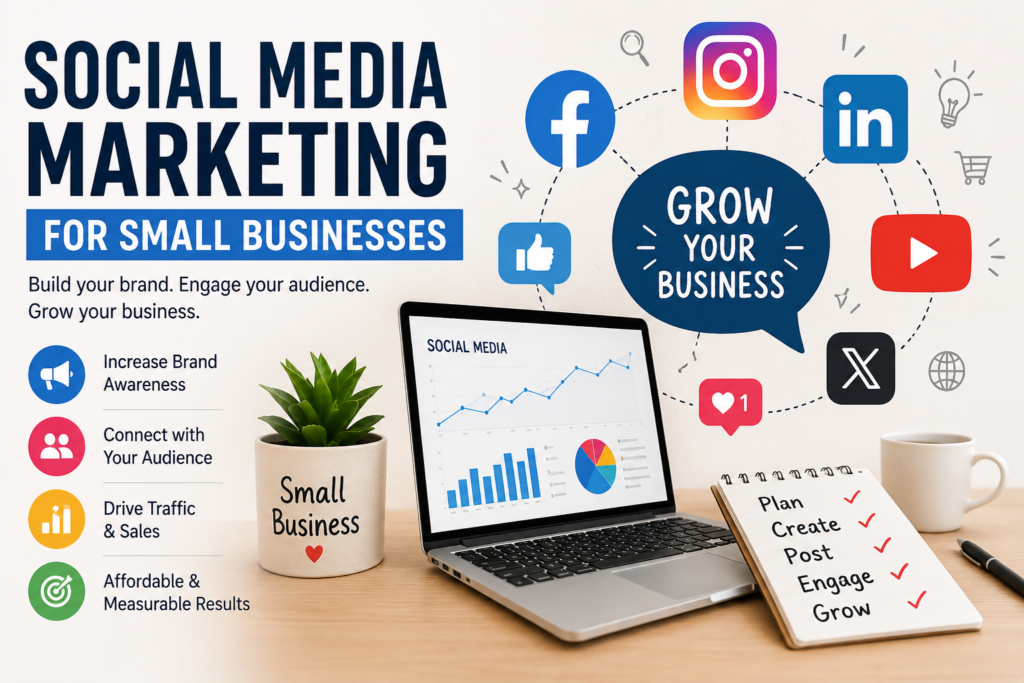
For small businesses, social media marketing for small businesses has emerged as one of the most effective ways to draw clients, raise brand awareness, and boost sales without having to invest large sums of money. Simply put, social media marketing is the use of websites like Facebook, Instagram, LinkedIn, YouTube, and X to advertise goods and services, engage with consumers, and foster online trust. Newspaper and television advertisements were only available to large corporations years ago. With just a smartphone and some imagination, even a small local business can now reach thousands of people. That is the true power of social media marketing for small businesses.
Consider how people use the internet. Every day, the majority of users browse social media in search of information, entertainment, product recommendations, or reviews. It’s like opening a store in the middle of a desert where no one comes by if your business is not operating there. Social media functions as a bustling marketplace with prospective clients who are already seeking information. Strangers can become followers, followers can become customers, and customers can become devoted fans with a well-thought-out social media presence.
Affordability is another factor that makes social media marketing crucial. Social media platforms enable small businesses to launch with little to no investment, whereas traditional marketing techniques frequently require large budgets. If the content is relatable and helpful, even organic posts can increase engagement. Every rupee matters because paid ads on social media sites like Facebook and Instagram enable precise targeting based on location, interests, age, and behavior.
The Significance of Social Media for Small Businesses
Being visible is crucial for small businesses. Sales will remain low even if you have a fantastic product or service if people are unaware of your company. This is where social media marketing can really make a big difference for small businesses. Social media platforms enable companies to reach the appropriate audience at the appropriate moment. Imagine running a bakery and sharing daily pictures of freshly made cakes on Instagram. Dessert-loving people in the area might find your page and start buying from you just because they saw your content online.
Additionally, social media fosters trust more quickly than traditional advertising. Before making a purchase, consumers frequently look at social media pages, online reviews, and comments. A company that shares helpful content and actively answers comments comes across as more reliable and competent. Your social media profile frequently serves as a second storefront in today’s digital world. People evaluate your brand by looking at how active, educational, and interesting your online presence appears to be.
Direct customer communication is one of the main benefits. Businesses can communicate instantly through comments, direct messages, polls, and stories rather than waiting for emails or phone calls. Customer satisfaction rises and relationships are strengthened as a result. Customers are more likely to come back and refer others to a business when they feel heard and appreciated. Social media allows word-of-mouth advertising to spread far more quickly than in offline settings.
Analytics also provide small businesses with important insights. Platforms offer data on demographics, post performance, engagement rates, and consumer behavior. Businesses can learn what works and what doesn’t from these insights. It’s similar to having a road map that directs your marketing choices rather than making haphazard guesses.
Social Media Marketing’s Advantages for Small Businesses
Likes and followers are just two of the many advantages of social media marketing for small businesses. Increased brand awareness is one of the main benefits. Each post, narrative, reel, or video serves as an online advertisement for your company. People are more likely to share your content with others if it is engaging. Businesses can reach a wider audience without investing a lot of money in advertising thanks to this natural sharing.
Lead generation and sales growth are two more significant advantages. These days, social media platforms are more than just apps for entertainment. They have developed into platforms for shopping and discovery where consumers actively look for goods and services. Businesses can more easily turn viewers into customers thanks to features like Facebook Marketplace, Instagram Shops, and product tagging. Within minutes, a small clothing store can direct customers to purchase links and use reels to highlight new arrivals.
Another significant advantage of social media marketing for small businesses is customer engagement. Instead of relying on one-way advertisements, social media allows businesses to start real conversations with their audience. Companies can build communities around their brand, ask questions, conduct surveys, and respond directly to comments. This interaction helps create emotional connections with customers. Through social media marketing for small businesses, consumers are more likely to trust and purchase from brands they feel connected to rather than from anonymous companies.
This straightforward table contrasts social media marketing with traditional marketing:
Features of Conventional Marketing, Social Media Marketing, Cost, Affordability, Audience Targeting, Limited, Extremely Specific Customer InteractionOne-Way, Two-Way, Performance Monitoring, Difficult, and Simple Analytics
Results Speed: Slow to Fast
Competitiveness is another hidden benefit. By producing relatable and genuine content, small businesses can compete with bigger brands. Nowadays, a lot of customers prefer to support small and local businesses because they feel more reliable and intimate. Consistency and inventive storytelling frequently outperform large advertising budgets.
Top Social Media Networks for Small Companies
Choosing the right platform is essential for effective social media marketing for small businesses. Not every social media platform works well for every type of business. Each platform has its own unique audience, content style, and user behavior. Understanding these differences helps businesses use their time, budget, and resources more efficiently. With the right approach to social media marketing for small businesses, companies can focus on platforms that bring the best engagement, reach, and business growth.
Facebook Promotion
Facebook remains one of the best platforms for social media marketing for small businesses because of its massive user base and powerful advertising system. Facebook pages, groups, and marketplace features are especially beneficial for local businesses. A restaurant, for example, can share menu updates, customer reviews, and promotional offers while also engaging with nearby communities. Through social media marketing for small businesses, Facebook Ads allow companies to target users based on location, interests, and buying behavior, making marketing campaigns highly effective even with smaller budgets..
Instagram Promotion
Fashion shops, cafes, salons, fitness centers, and travel brands are among the visually appealing businesses that are best suited for Instagram. Creative marketing opportunities are created by reels, stories, and carousel posts. Instagram users expect new and interesting content on a regular basis, so consistency is crucial. Compared to simple promotional posts, short videos featuring product demonstrations or behind-the-scenes moments frequently perform better.
LinkedIn Promotion
LinkedIn is most useful for professionals, consultants, agencies, and B2B companies. LinkedIn prioritizes professional networking and educational content, in contrast to entertainment-focused platforms. By disseminating case studies, success stories, and industry insights, businesses can establish authority. For service-oriented companies looking for quality leads, this platform is especially helpful.
YouTube Promotion
When it comes to video content, YouTube is king. To draw viewers, companies can produce brand narratives, instructional videos, product reviews, and tutorials. Because consumers can see actual explanations and demonstrations, video marketing boosts trust. For instance, a small tech store can produce smartphone review videos and gradually develop a devoted following.
Developing a Successful Social Media Plan
Social media marketing turns into aimless, haphazard posting in the absence of a plan. Setting specific objectives is the first step in a successful social media marketing strategy for small businesses. Companies need to ask themselves things like, “Do we want more followers, website traffic, sales, or customer engagement?” Well-defined objectives offer concentration and facilitate performance evaluation.
Comprehending the intended audience is equally crucial. Because they produce content for everyone rather than targeted audiences, many businesses fail. A financial consulting firm that targets professionals will use different language, graphics, and platforms than a gym that targets teenagers. It is easier to produce highly relevant content when one is aware of the interests, problems, and behaviors of the audience.
More important than quantity is the quality of the content. Only worthwhile content attracts users’ attention because they are continuously inundated with information on the internet. Constant sales promotions typically don’t work as well as educational advice, entertaining videos, relatable stories, and motivational posts. Social media can be compared to forming friendships. People quickly become disinterested if every conversation is about selling.
Another important component is consistency. It won’t gain momentum to post once a month and then stop. Companies should post frequently and keep a content calendar. Audiences are better able to identify and recall a company when its branding, tone, and visuals are consistent. Consistency fosters authority and trust over time.
Ideas for Social Media Content for Small Companies
Choosing what to post online is a challenge for many business owners. The good news is that social media marketing for small businesses has countless content options. Because it offers audiences value, educational content is among the most effective formats. Businesses can establish themselves as experts by using industry insights, how-to manuals, tutorials, and tips.
Because it feels genuine and intimate, behind-the-scenes content also does incredibly well. Consumers like learning about the individuals, procedures, and narratives that go into a brand. Viewers are emotionally connected when a clothing store displays packing orders or a bakery shares videos of cake preparation.
Testimonials from customers are another effective kind of content. Advertisements are less effective at fostering trust than genuine customer experiences. Positive evaluations, before-and-after photos, or video endorsements boost the company’s credibility and entice potential clients to give it a try.
Here are some ideas for interesting content:
Tutorials for products
Success stories from customers
Everyday advice
Introductions to the team
Quizzes and polls
Videos from behind the scenes
Updates on industry news
In social media marketing, storytelling is particularly effective. Stories are more relatable to people than sales pitches by nature. By sharing challenges, successes, and business experiences, the brand becomes more relatable and human.
Typical Errors Small Businesses Should Avoid
Despite its potential, social media marketing for small businesses can backfire if companies make common mistakes. Posting without a plan is one of the biggest errors. Purposeless, haphazard posts erode brand identity and confuse viewers. Every piece of content should be in line with audience interests and business objectives.
Another significant issue is ignoring analytics. Many companies ignore deeper metrics like engagement rates, reach, click-through rates, and conversions in favor of concentrating solely on likes and followers. Analytics offer insightful information that enhances upcoming campaigns. Businesses are unable to determine what content actually works without analyzing results.
Another problem is excessive product promotion. Continuous commercials quickly cause viewers to lose interest. Instead of constant sales pitches, social media users seek inspiration, education, and entertainment. It is far more effective to use a balanced content strategy that combines promotions and value-driven content.
Inconsistency is another frequent error. Some companies post frequently for a week before going months without posting. It takes time and perseverance to develop an online following. Success on social media seldom happens quickly. It is more akin to sowing seeds and consistently tending to them until they develop into robust trees.
Social Media Marketing’s Future
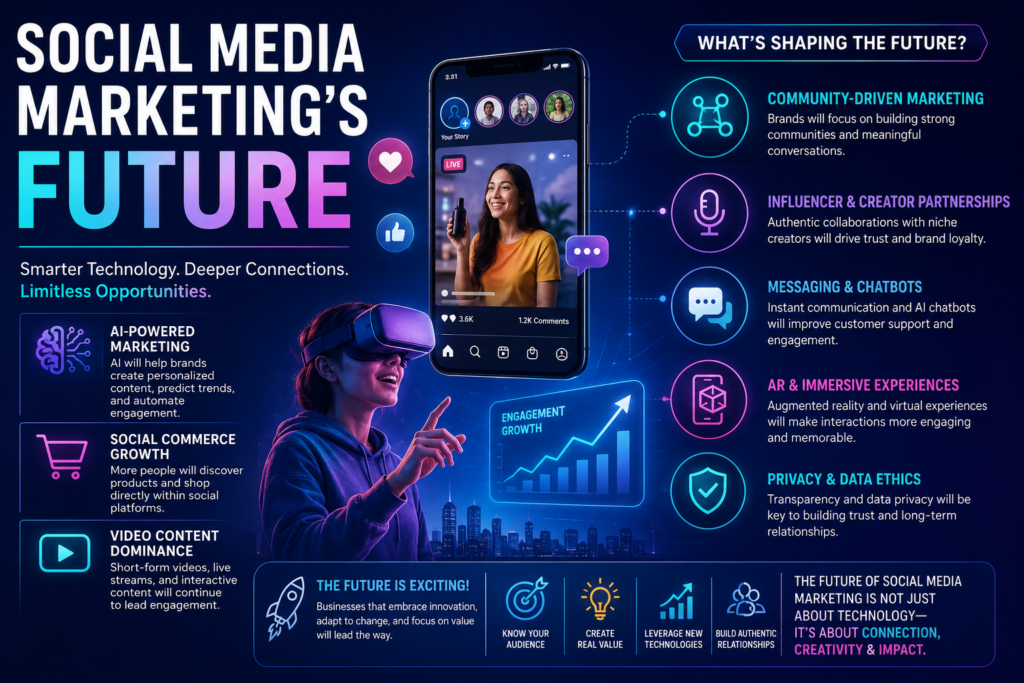
Social media marketing for small businesses appears to have a very bright future. Platforms are still dominated by video content, particularly short-form videos like YouTube Shorts and Instagram Reels. Companies that follow the trends in video will probably see an increase in visibility and engagement.
Additionally, artificial intelligence is changing marketing tactics. Businesses can now schedule posts, analyze performance, create captions, and even come up with content ideas with the aid of AI tools. For resource-constrained small business owners, this lessens workload and boosts productivity.
Another emerging trend is social commerce. Customers can now find and buy products without ever leaving social media thanks to platforms’ direct integration of shopping features into apps. This improves customer satisfaction and boosts conversion rates.
Additionally, authenticity is becoming more and more important to consumers. Sincere, relatable content is becoming more effective than polished corporate ads. Compared to large corporations, small businesses actually have an advantage in this situation because they are better able to establish personal connections and tell authentic stories.
In conclusion
In today’s digital world, social media marketing for small businesses is no longer optional. It has developed into one of the best strategies for raising awareness, drawing clients, and fostering enduring brand loyalty. Even small local businesses can compete with larger corporations and build robust online communities with the correct approach.
Understanding your audience, being creative, and being consistent are the keys to success in social media marketing. Over time, companies that prioritize delivering value over continuously selling goods frequently see improved outcomes. Building relationships, trust, and meaningful customer experiences are all important aspects of social media.
Businesses that remain flexible and receptive to new trends will have the biggest advantage as platforms continue to change. When utilized properly, social media presents countless chances for expansion for businesses of all sizes, including startups, small businesses, independent contractors, and service providers.
FAQs
1. What makes social media marketing crucial for small companies?
Compared to traditional advertising, social media marketing helps small businesses connect with customers, build brand awareness, produce leads, and increase sales at a lower cost.
2. What social media site is ideal for small companies?
The type of business determines which platform is best. LinkedIn is best suited for professional services, Facebook is excellent for local businesses, Instagram is good for visual brands, and YouTube is perfect for video marketing.
3. How frequently should small companies update their social media accounts?
Frequency is not as important as consistency. Maintaining audience engagement usually requires posting three to five high-quality posts a week.
4. Can sales be boosted by social media marketing?
Indeed, by drawing in targeted audiences, fostering trust, and directing consumers toward purchases through compelling content and ads, social media marketing can directly boost sales.
5. What kind of content is most effective on social media?
Because they offer value and foster emotional connections, instructional posts, brief videos, client endorsements, behind-the-scenes content, and storytelling typically do very well.